
 Blog
Blog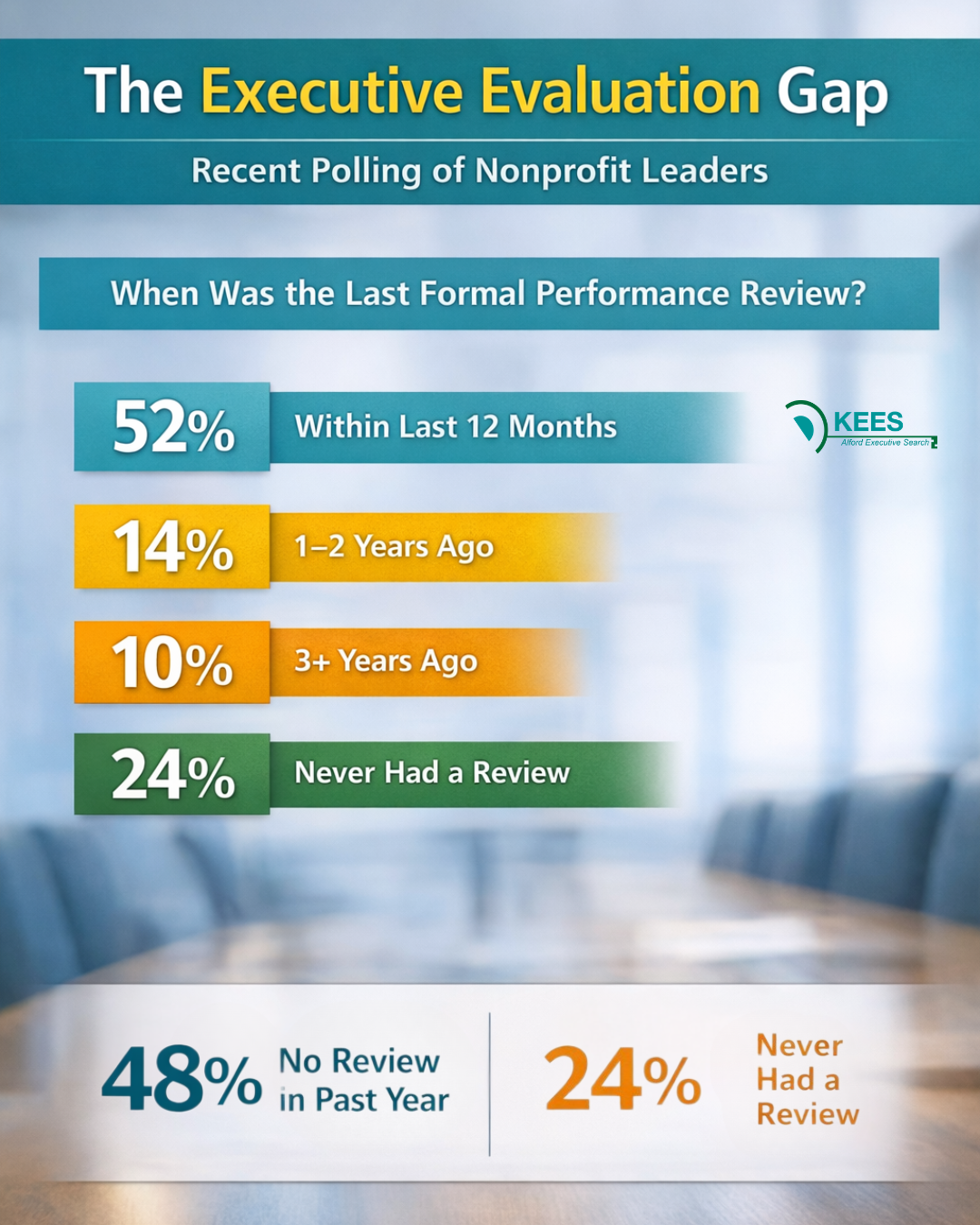
Summary: KEES data reveals a significant gap in nonprofit governance: nearly half of nonprofit executives do not receive annual performance reviews. KEES insights explores why Board Chairs must prioritize formal evaluations and compensation analysis to ensure organizational stability, mission accountability, and leadership success.
Strong nonprofit leadership begins with strong governance. One of the most important responsibilities of a board and a key duty of the Board Chair is the oversight and support of the organization’s chief executive leader. Recent polling by KEES reveals a significant gap in this practice. Nearly half of nonprofit executives report they are not receiving regular performance evaluations from their boards.
KEES Data: A Wake-Up Call
To better understand governance practices across the sector, KEES asked nonprofit professionals a simple question: “When was the last time the Board conducted a formal performance review of the CEO, Executive Director, or President?”
Combined results from polling conducted in October 2025 and February 2026 reveal concerning trends:
- • 52% reported receiving a performance review within the past 12 months
- • 48% have not received a formal review in more than a year
- • 24% (nearly one in four) reported never receiving a formal review
Perhaps most striking, the number of respondents reporting “Never” increased from 12.5% in late 2025 to 32% in early 2026.
These findings mirror national governance research. According to BoardSource’s Leading with Intent: BoardSource Index of Nonprofit Board Practices, only 53% of nonprofit CEOs reported receiving a formal written performance evaluation in the previous year, while 21% reported never receiving one from their board. (Source)
Together, these data points suggest that many nonprofit boards are not consistently fulfilling one of their most fundamental governance responsibilities.
The Board Chair’s Responsibility
For Board Chairs, conducting an executive evaluation is more than a recommended practice. It is a core governance responsibility that strengthens both leadership and accountability.
A structured evaluation process helps boards:
- • Align expectations
- • Strengthen the leadership partnership
- • Inform compensation decisions
- • Ensure accountability
When conducted consistently and thoughtfully, executive evaluations reinforce transparency, build trust, and support long-term organizational stability.
How KEES Supports High-Impact Boards
Many boards recognize the importance of executive evaluations but struggle with where to begin. A lack of clear process, uncertainty about evaluation methods, or discomfort with structured feedback often leads boards to rely on informal check-ins instead of formal reviews.
Our team partners with nonprofit leaders to strengthen governance and leadership practices through expertise in:
- • Executive Search and Leadership Transitions
- • Executive Performance Evaluation Systems
- • Compensation Benchmarking and Analysis
- • Leadership Succession Planning
By providing clear frameworks and objective data, KEES helps boards support their executives while maintaining strong governance standards.
A Moment for Reflection
When was the last time your board conducted a formal performance review of your executive leader? Revisiting this question can be the first step toward stronger governance, clearer leadership expectations, and a more resilient organization.
Connect with KEES here to learn how we can support your board in building a stronger leadership partnership.